ExercisesRows
How to do the Barbell Row, and what it works.
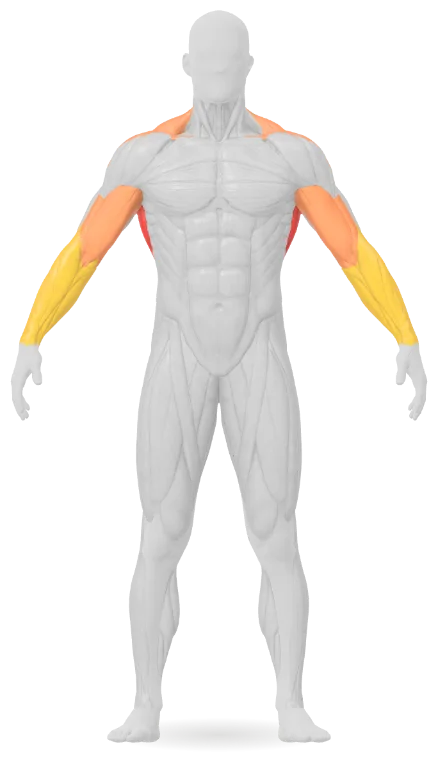
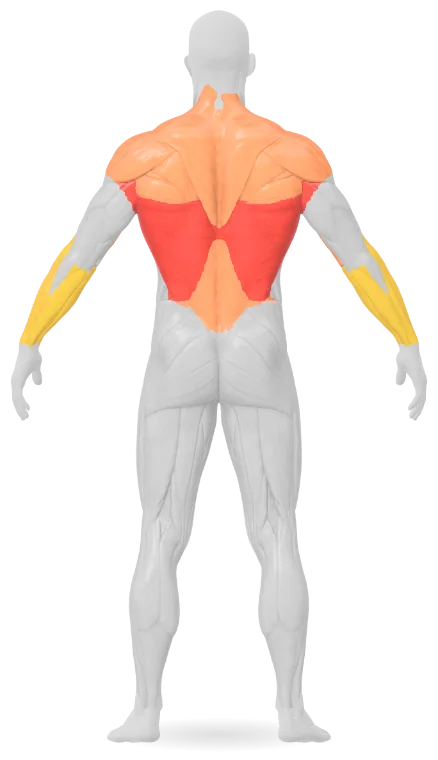
To do the Barbell Row, stand with your feet hip-width apart, the bar over your mid-foot, then pull the bar to your lower ribs, driving your elbows back. The Barbell Row works your lats most, with your upper back (traps), rear shoulders, biceps and lower back helping, and its page in Vayen lights those muscles on a 3D body.
One week free · No account needed · Built for iPhone
- Works most
- Lats
- Also works
- Upper back (traps), rear shoulders, biceps, lower back and forearms
- Equipment
- Barbell
In short
- The Barbell Row works the lats as its prime mover.
- The Barbell Row also works the upper back (traps), rear shoulders, biceps and lower back, with the forearms assisting.
- The Barbell Row is a row exercise done with a barbell.
- In Vayen the Barbell Row keeps its own records, and its page lights the muscles it works on a 3D body.
- The Barbell Row is also called the Bent-over Row.
How do you set up for the Barbell Row?
- Stand with your feet hip-width apart, the bar over your mid-foot.
- Grip the bar just outside your knees.
- Bend your knees slightly and hinge at the hips until your back is at about 45°.
- Keep your back flat and your arms hanging straight.
How do you do the Barbell Row?
- Pull the bar to your lower ribs, driving your elbows back.
- Squeeze your shoulder blades together at the top.
- Lower the bar slowly until your arms are straight.
- Keep your back at the same angle the whole set.
How should you breathe during the Barbell Row?
Breathe in and brace before each rep, breathe out as you lower.
Where should you feel the Barbell Row?
Across your upper and middle back, with your biceps and lower back helping.
What are the most common Barbell Row mistakes?
- Standing up more with every rep.
- Rounding your lower back.
- Jerking the bar up with your hips.
How do you make the Barbell Row easier?
Try a chest-supported row or a cable row, which take the lower back out of it.
What are the benefits of the Barbell Row?
- The Barbell Row builds your back by pulling a heavy barbell toward your belly.
- It trains your lats, upper back, rear shoulders and biceps, and your lower back and forearms work to hold you in position.
- It builds a strong upper back and carries over to every other pulling exercise.
- It suits lifters who want a heavy, powerful back exercise.
Can you do the Barbell Row at home?
Not really, because it needs a barbell and weight plates.
The closest home version is a dumbbell row, or an inverted row under a sturdy table.
Try the Dumbbell Row or the Inverted Row.
How do you do the Barbell Row safely?
Before you go onIf your lower back tires before your upper back, stop the set.
What are the Barbell Row variations?
In Vayen you can say exactly which version you did, and each one keeps its own records.
You may also know it as the Bent-over Row.
- Supinated — palms facing forward. More biceps and lower lats.
- Wide — hands wider. More upper back and rear shoulders.
| Choice | Options |
|---|---|
| Grip | Pronated (overhand) · Supinated (underhand) |
| Width | Narrow (close grip) · Standard (shoulder width) · Wide (outside shoulders) |
What can you do instead of the Barbell Row?
These are the exercises Vayen’s swap suggests for the Barbell Row when the kit is taken or you want something different: the same kind of movement, working the same muscles.
- Dumbbell Row: dumbbells; works your lats most.
- Cable Row: cable; works your lats most.
- T-bar Row: plate-loaded machine; works your lats most.
- Machine Row: machines; works your lats most.
- Inverted Row: bodyweight; works your lats most.
Rows3D
What muscles does the Barbell Row work?
The Barbell Row works your lats most, with your upper back (traps), rear shoulders, biceps and lower back helping. Vayen counts each set fully toward a prime mover, half toward a muscle that works hard as a helper and a quarter toward one that steadies or assists, so your weekly sets per muscle add up honestly.
- Lats (the sides of your back)Prime mover
- Upper back (traps)Works hard as a helper
- Rear shoulders (rear delts)Works hard as a helper
- BicepsWorks hard as a helper
- Lower backWorks hard as a helper
- Forearms and gripSteadies or assists
How do you track the Barbell Row in Vayen?
Vayen is an iPhone gym tracker (strength-training log) that is as simple or as detailed as you train. Add the Barbell Row to a workout once and Vayen remembers how you did it.
See how Vayen’s exercise library works, and what the 3D muscle figure shows.
- Its exercise page lights the muscles the Barbell Row works on Vayen’s 3D figure, the prime movers brightest.
- These steps, mistakes and variations are in the app too, under How to do it, beside the exercise mid-workout.
- Last time’s weight and reps are already in the row, so logging a set is one tap.
- A new record is starred the moment you set it.
Questions people ask
How do you do a Barbell Row?
Stand with your feet hip-width apart, the bar over your mid-foot. Pull the bar to your lower ribs, driving your elbows back. Keep your back at the same angle the whole set.
What muscles does the Barbell Row work?
The Barbell Row works your lats most, with your upper back (traps), rear shoulders, biceps and lower back helping. Your forearms steady the movement.
Barbell Row vs Dumbbell Row: what is the difference?
Both work your lats most. The Barbell Row is done with a barbell, and the Dumbbell Row with dumbbells. Neither is better for everyone: pick the one that suits your gym and your body. Vayen keeps separate records for each.
Is the Barbell Row good for beginners?
Yes. The Barbell Row is one of the common exercises Vayen shows first in Beginner mode. Start light and learn the movement before you add weight. To make it easier: Try a chest-supported row or a cable row, which take the lower back out of it.
How many sets and reps of the Barbell Row should you do?
For strength, 3 to 5 sets of 3 to 6 reps; for muscle, 2 to 4 sets of 6 to 12 reps. Stop most sets a rep or two short of failure, and add weight when every set reaches the top of your range. Vayen fills in last time’s numbers, so you always know what to beat.
Reviewed